
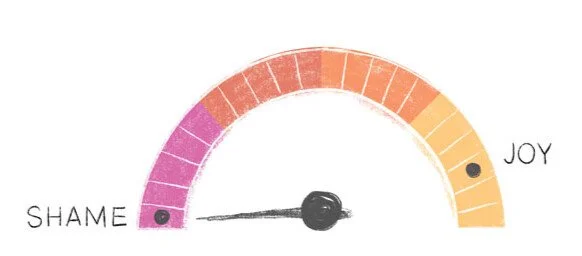
Shame
A low-energy, inward emotional state that often brings collapse, self-judgment, and withdrawal.
How You Might Feel
Shame often shows up as a heavy, sinking feeling in the chest or stomach, like something in you is folding in on itself. Your body gets smaller. You avoid eye contact. Heat rises in the face.
Your mind turns sharp and fast: “I should have known better…” “What’s wrong with me…” “I messed everything up…”
It feels isolating, even when nothing is actually wrong with you.
What Shame is Signaling
Shame is not proof that you’re broken.
It’s a threat response — your nervous system trying to protect you from rejection or judgment.
It often shows up when:
You fear disappointing someone
You’re comparing yourself to an impossible standard
You’ve tied your worth to an identity (“the good parent,” “the capable one,” “the stable one”)
You’re stepping into something new and old wiring says, “Don’t get this wrong.”
Shame is a roadblock, not a dead end.
And it dissolves when you meet it with clarity and kindness.
Tool Library
Two ways to work with this emotion - for right now and for later. You don’t need to use all of them. Start with what your system has room for.
Tools for In The Moment
Tool 1: Hazards On: Shame
Calms your body, softens the inner critic, and brings your system back online.
TIME: 90 seconds
TYPE: 🫁 Body & Breath
USE THIS WHEN: You’ve just experienced something that triggered shame.
-
How to Do It
Pause and place one hand on your chest.
Feel the contact. Let your breath drop a little lower.
Name it gently:
“This is shame.”
Naming turns the experience into data, not identity.
Add common humanity:
“Everyone feels this. This is part of being human.”
Take one slow, grounding breath.
In through the nose, out longer through the mouth.
Let the intensity drop even 10%.
That’s enough for now.
Why This Works (Science Inside)
Shame creates a rapid self-attack loop that floods the nervous system.
Gentle touch activates the vagus nerve, naming engages the prefrontal cortex, and common-humanity cues decrease isolation. Together they interrupt threat signaling and restore physiological safety so clarity can return.
Tools to Build Your Skills Over Time
Tool 1: Meet Your Inner Critic
Turn harsh judgment into clarity, care, and choice.
TIME: 5–15 min
TYPE: ✍ Reflection & Writing
USE THIS WHEN: You want to befriend your self-critical voice and understand what it’s protecting.
-
How to Do It
Choose a light example.
Bring to mind a moment you felt “not enough.” Keep it gentle.
Write the shame sentence.
The exact words the critic said:
“You blew it.”
“You should know better.”
“Everyone can see you’re not good enough.”
Identify the fear underneath.
Ask on paper:
“What is this part afraid will happen?”
“What consequence is it trying to prevent?”
Shame almost always protects against a deeper fear — rejection, judgment, failure, not belonging.
See the function, not the failure.
Write:
“This part is trying to protect me by…”
(keeping me safe, preventing embarrassment, avoiding a wound)
Write a warm response back.
As if you’re the wise adult in the room:
“I hear you. I know you’re trying to help. I’m here.”
“You don’t need to yell — I won’t abandon myself.”
Close with one grounding gesture.
One breath, hand over heart, slower exhale.
Why This Works (Science Inside)
Writing externalizes shame, reducing fusion with the harsh narrative.
Identifying the underlying fear reframes the critic as a protective part rather than a judgment about your worth. Warm reappraisal activates the brain’s caregiving circuitry, increasing oxytocin and downregulating threat responses. Over time, this rewires how shame is interpreted, making future spikes shorter and less overwhelming.
💡 The Relationship Between Shame & Self-Abuse
Shame is the emotion.
It’s a fast, body-based signal of exposure or “not enough” — a drop in the stomach, heat in the face, the urge to hide.
Self-abuse is the story.
It’s the learned inner language layered on top of shame:
“I’m an idiot,” “Everyone sees I’m failing,” “Why do I always mess this up?”
How they interact:
Shame is the spark.
Self-abuse is the fuel that keeps the spark burning long after the moment has passed.
Shame lasts seconds.
Self-abuse can last hours.
When you can tell the difference, you gain power.
You can’t stop shame from arising — but you can interrupt the story that makes it grow.
*Use the practices above to interrupt the self-abusive storyline and reconnect to the softer signal underneath.*