
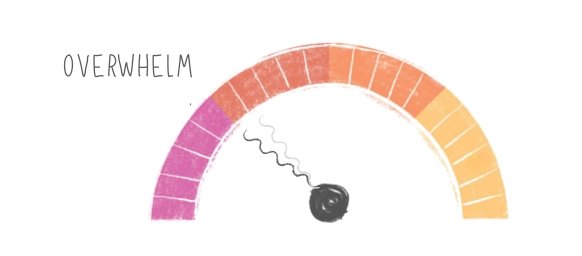
Overwhelm
A flooded, overloaded state where your system is receiving more input — emotional, cognitive, or logistical — than it can process.
How You Might Feel
Overwhelm often feels like too many tabs open at once — your mind racing, your breath getting tight, and your attention pulled in multiple directions. You might feel rushed, scattered, foggy, or unable to decide what to do first.
Even small tasks can feel big. You may bounce between frantic activity and wanting to shut down altogether.
What Overwhelm is Signaling
Overwhelm is a capacity signal. It shows up when the demands on your system exceed the resources you have available in that moment.
It can signal:
you’re trying to hold too many things alone
your pace is unsustainable
you’re expecting instant clarity where gentleness is needed
you’re carrying emotional weight underneath the tasks
you haven’t had space to process, rest, or re-center
Overwhelm isn’t a personal failure. It’s your system saying, “I’m over capacity. Something needs to change.”
Once you understand that overwhelm is a signal — not a character flaw — you can work with it instead of pushing through it.
Tool Library
Two ways to work with this emotion - for right now and for later. You don’t need to use all of them. Start with what your system has room for.
Tools for In The Moment
Tool 1: Next Brick Only
Uses breath and grounding to steady your system just enough to ride the wave instead of bracing against it.
TIME: 1-2 minutes
TYPE: ✍ Reflection & Writing
USE THIS WHEN: Your mind is racing and everything feels urgent.
-
How to Do It
Stop scanning the whole list.
Ask: “If I only do one tiny brick in the next 5 minutes, what is it?”
Pick the smallest action: Open the document. Put one dish in the sink. Write one subject line. Nothing more.
Do that one brick. Then pause. Let that be enough.
Let your load shrink, even 10%. You’re getting clear, not productive.
Why This Works (Science Inside)
Overwhelm is a perceived load problem, not a capacity problem. Narrowing the horizon reduces cognitive flooding and helps the brain shift from threat mode into task mode. A single bounded action restores a sense of agency and downshifts your stress response.
Tools to Build Your Skills Over Time
Tool 1: The Load Audit
Sort real load from imagined load so your system can settle and regain direction.
TIME: 5-10 min
TYPE: ✍ Reflection & Writing
USE THIS WHEN: Everything feels urgent, scattered, or too much.
-
How to Do It
1. Set up three columns:
Now / Later / Not Mine.
2. Do a full brain-dump.
Write everything swirling around — big, tiny, vague, logistical, emotional.
Get the whole storm onto the page.
3. Sort each item:
Now: truly today.
Later: this week or beyond.
Not Mine: someone else’s expectations, emotions, or timeline.
4. Circle just one Now item.
That becomes your focus.
5. Cross out every Not Mine item.
Say “Not mine to carry” if it feels natural.
Why This Works (Science Inside)
Overwhelm happens when the mind is juggling too many unsorted inputs at once, which overloads working memory and keeps the threat system activated.
Getting it onto paper instantly lightens the mental strain, while sorting brings back a sense of order and clear direction.
Saying “not mine” out loud adds a subtle benefit: spoken language engages different neural pathways than internal thought, helping the brain register the boundary more firmly. It’s a tiny ritual that reinforces emotional detachment and calms the stress cycle.