
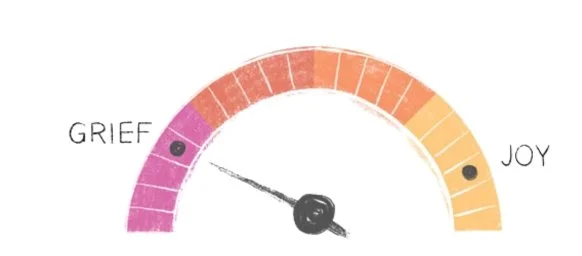
Grief
A slow, heavy emotional state marked by sadness, longing, and the sense of losing something you can’t easily replace.
How You Might Feel
Grief feels heavy and tender at the same time — like something in you is sinking while something else is stretching wide open. It can show up as a tight chest, a hollow belly, a lump in the throat, or an ache behind the eyes. You might feel slow, foggy, easily overwhelmed, or suddenly tearful for no clear reason. Grief doesn’t always look dramatic — sometimes it’s quiet, tired, and steadying itself.
It can feel like “I miss what was,” or “I don’t know who I am without this,” even when the loss is invisible to everyone else.
What Grief is Signaling
Grief is not a sign that you’re weak or behind. It’s a signal that something meaningful has changed — a role, a dream, a relationship, a rhythm, a version of you — and your system is recalibrating.
Grief often rises when:
A chapter is ending (even if you chose it)
You’re letting go of an identity that once fit you
Life didn’t turn out the way you imagined
Someone or something you relied on is no longer there
You’re growing, and growth always asks a trade-off
Grief is your body saying,
“This mattered. I mattered here.”
It’s a natural part of transition, not a problem to fix. And it doesn’t mean you’re stuck — it means you’re honoring what was so you can eventually step into what’s next.
Tool Library
Two ways to work with this emotion - for right now and for later. You don’t need to use all of them. Start with what your system has room for.
Tools for In The Moment
Tool 1: A Rest Stop for Grief
Uses breath and grounding to steady your system just enough to ride the wave instead of bracing against it.
TIME: 90 seconds
TYPE: 🫁 Body & Breath
USE THIS WHEN: A wave of grief rises unexpectedly and you need a doable pause, not a fix.
-
How to Do It
Pause and soften your pace.
Sit or stand. If it helps, place a hand on your chest.
Let your breath slow by even 5%.
Name the wave.
Try:
– “A wave of grief is here.”
– “Something in me is hurting.”
– “This is a moment of loss.”
Naming acknowledges the wave without trying to interpret it.
Notice one thing that hurts.
A memory, an absence, a longing, a shift.
No need to explore — simply witness it.
Offer one line of kindness.
– “Of course this hurts.”
– “This mattered to me.”
– “I’m allowed to feel this.”
Take one small grounding action.
A sip of water.
A stretch.
A hand over your heart.
A breath of fresh air.
The goal isn’t relief — it’s support.
Why This Works (Science Inside)
Grief arrives in waves the nervous system temporarily interprets as threat. Soft naming reduces overwhelm by bringing the prefrontal cortex back online.
Gentle grounding cues parasympathetic safety, allowing the wave to move at its own pace rather than intensify.
You’re not resolving grief — you’re giving your system a way to stay present without collapsing.
Tools to Build Your Skills Over Time
Tool 1: Name the Loss, Name the Life
Helps your system integrate what happened so grief can move at its own slow pace.
TIME: 5-10 min
TYPE: ✍ Reflection & Writing
USE THIS WHEN: You want to gently understand what a loss changed in you and how to support yourself moving forward.
-
Important Note
This is not an “in the moment” tool.
Grief moves slowly and in layers.
This exercise helps you make sense of loss—not solve it, speed it up, or tidy it.
How to Do It
1. Describe what changed.
Write one clear sentence about the loss:
“Something I depended on is gone.”
“A role that shaped me has ended.”
“A version of myself is no longer here.”
This names the landscape, not the emotion.
2. Identify what the loss meant to you.
Ask:
“What did this give me when I had it?”
Write one line:
“It helped me feel grounded.”
“It connected me to others.”
“It gave me purpose.”
This reveals the value beneath the pain.
3. Notice what your heart is asking for now.
Gently ask:
“What part of me needs attention or support because of this?”
Possibilities:
Rest
Stability
Creativity
Connection
Identity
Ritual
Do not force an answer. A guess is enough.
4. Choose one tiny honoring gesture.
Not to make grief go away—only to acknowledge what mattered.
Examples:
Light a candle.
Carry a stone.
Write one sentence.
Step outside for a breath.
Look at a photo.
Sit in silence for 30 seconds.
This is about respect, not resolution.
5. Close with a simple truth.
Say quietly:
“This mattered.”
“This is part of being human.”
“I’m allowed to feel this.”
Stop there. No analysis.
Why This Works (Science Inside)
Grief becomes overwhelming when it stays formless.
This exercise gives your brain structure: a way to organize what was lost, what it meant, and what needs care now.
Meaning-making recruits higher brain networks that help integrate emotional pain without shutting down or spiraling.
Tiny honoring gestures activate the brain’s soothing pathways, signaling that the loss is held rather than avoided—allowing grief to move through instead of getting stuck.