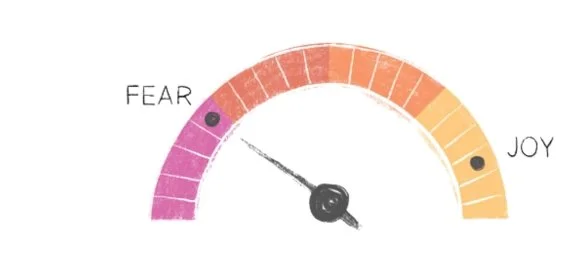
Fear
A high-alert, tightening state that pulls your attention toward danger — whether it’s real or imagined.
How You Might Feel
Fear often arrives as a quickening: a rush of energy up the spine, a tightening in the belly, a squeeze in the chest. Your breath gets shallow. Your thoughts speed up. Your body braces before your mind even knows why.
Sometimes fear feels sharp and immediate — like your system is sounding an alarm. Other times it’s quieter, like a hum beneath everything, keeping you tense and restless without a clear target. You might feel jumpy, hesitant, vigilant, or suddenly small. Decisions feel risky. The world feels closer in.
Fear narrows your focus to survival. It makes everything feel urgent, even when nothing is actually threatening you.
What Fear is Signaling
Fear is not a character flaw. It’s your nervous system trying to keep you safe — sometimes from real risks, and sometimes from imagined ones shaped by past experiences, old wounds, or inherited stories about what happens when you fail, disappoint, or stand out.
Fear often signals one of three things:
Something matters to you. Fear gathers around the things you don’t want to lose.
You’re stepping into the unknown. Newness can feel dangerous to a system wired for predictability.
An old pattern is being activated. Your body remembers previous pain even when your mind doesn’t connect the dots.
Fear is your system saying, “Slow down. Notice this. You’re crossing into territory that matters.”
It’s not a stop sign; it’s an invitation to move with care.
Tool Library
Two ways to work with this emotion - for right now and for later. You don’t need to use all of them. Start with what your system has room for.
Tools for In The Moment
Tool 1: Look Around the Room
A grounding reset that pulls you out of imagined danger and back into the safety of the present moment.
TIME: 90 seconds
TYPE: 🫁 Body & Breath
USE THIS WHEN: Your mind is spiraling into worst-case scenarios.
-
How to Do It
Stop bracing.
Lift your eyes and look slowly around the room.
Name 3 things you can see.
Name 2 things you can hear.
Name 1 thing you can touch.
Let the world come into focus.
Right now, I am physically safe.
That’s enough for this moment.
Why This Works
Fear lives in imagined danger. Orienting pulls attention into the present moment, interrupting catastrophic simulation and reactivating the prefrontal cortex. Sensory grounding reduces amygdala activity and signals to the nervous system: “No threat right now.”
Tools to Build Your Skills Over Time
Tool 1: Courage Calibration
A brief pull-off to steady yourself and get back on the road.
TIME: 3-5 min
TYPE: 🧭 Mind & Meaning
USE THIS WHEN: Fear is talking you out of something meaningful.
-
How to Do It
1. Choose one thing fear is blocking.
A conversation.
A boundary.
An email.
A possibility.
Keep it small and real.
2. Find the 1% version.
Ask:
“What is the tiniest version of this that I can do?”
It might be writing the person’s name, opening the document, or standing near the task.
3. Do the 1% action.
Just that.
Not the whole thing — the micro-move.
4. Notice what shifted.
Even if fear lingers, momentum changed. Your system learns: 'I can move, even with fear present.
Why This Works (Science Inside)
Fear isn’t a sign to stop — it’s a signal that something matters. When you shrink an avoided task into its tiniest possible version, the brain’s threat response settles and the prefrontal cortex comes back online. This gentle pairing of fear + small action teaches your system that you can approach something without becoming overwhelmed. Over time, these micro-exposures rewire avoidance patterns and build genuine confidence.