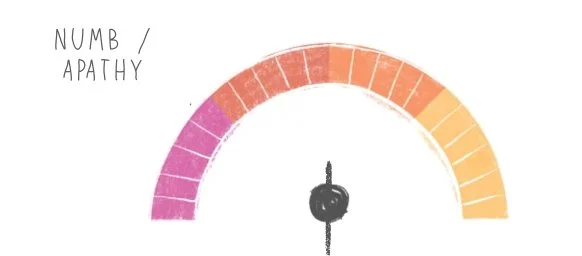
Apathy
A shutdown state where sensation, emotion, and clarity go offline, leaving you flat, disconnected, or blank.
How You Might Feel
Numbness often feels like a muted version of yourself. You may feel foggy, tired, or hard to reach. Your body can feel heavy or distant. The world feels slightly dimmed or far away. You might notice you are going through the motions without really being present, or that you can’t tell what you feel at all.
Apathy can show up as “I don’t care,” but underneath it there is usually exhaustion, discouragement, or a sense that trying will not change anything. You might struggle to start tasks, make decisions, or connect with others. Even things that normally matter feel neutral or irrelevant.
Both states can make you feel like you are paused inside your own life.
What Numbness or Apathy is Signaling
Numbness is often a protective response. When something has felt overwhelming for too long, your system may shut down sensation to keep you from tipping into overload. It is the body’s way of giving you distance when things feel too big to process.
Apathy can signal depletion, discouragement, burnout, or a loss of hope. It can also be a sign that you have been operating without enough support or space to feel what is underneath. Sometimes apathy shows up when you have been holding everything together for too long.
Neither state means you lack emotion. It means your system needs rest, care, and a slower, gentler approach before it can come back online.
Tool Library
Two ways to work with this emotion - for right now and for later. You don’t need to use all of them. Start with what your system has room for.
Tools for In The Moment
Tool 1: One Sensory Spark
Uses breath and grounding to steady your system just enough to ride the wave instead of bracing against it.
TIME: < 1 minute
TYPE: 🫁 Body & Breath
USE THIS WHEN: You feel shut down, flat, or disconnected.
-
How to Do It
Stop forcing yourself to “feel.”
Pick one gentle sensory contrast:
Step outside for 10 seconds.
Splash cool water on your face.
Hold a cold mug.
Put on one song and stand while it plays.
Just one spark — not a full reboot.
Let your system rise one notch.
One notch is enough.
Why This Works (Science Inside)
Shutdown states are low-arousal, not low-willpower. A small sensory contrast increases alertness and activates the brain’s wakefulness network (the reticular activating system), nudging the system upward just enough to re-engage.
Tools to Build Your Skills Over Time
Tool 1: Micro-Mastery
Restore spark and momentum through tiny, confidence-building actions.
TIME: 5-15 min
TYPE: 🫁 Body & Breath
USE THIS WHEN: You feel flat, blank, disconnected, checked-out, or unable to start anything.
-
How to Do It
1. Pick something tiny you want to get better at.
Keep it simple and low-stakes: making tea, stretching, clearing one corner of a table, watering a plant.
2. Define the 2-minute version.
Small enough that you almost roll your eyes because it’s so doable.
3. Do it daily for 5 days.
Same time or same cue — consistency matters more than effort.
4. Track one small win each day.
Write down one line:
“I showed up.”
“One notch higher.”
“It felt good to move.”
Even if it felt mechanical—no judgment—that counts.
Why This Works (Science Inside)
Numbness and apathy are low-arousal states where the nervous system has downshifted to conserve energy. Micro-actions wake the system gently without pressure.
Completing small, predictable tasks triggers a small dopamine release — the brain’s “keep going” signal — which gradually rebuilds motivation and energy.
Over several days, these micro-mastery loops create upward momentum and restore a sense of capability.