
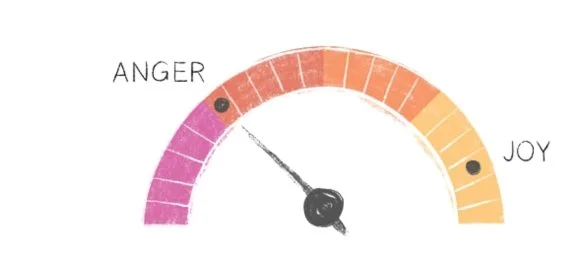
Anger
A high-energy activation state that rises when a boundary is crossed or something feels unjust, blocked, or threatening.
How You Might Feel
Anger often shows up as heat under the skin, clenched fists, or a fast surge of energy moving up and out. You might feel tight in your jaw, shoulders, or hands, with flushed face, flared nostrils, or rapid, shallow breathing. Thoughts can get louder and sharper. Everything in you may pull forward, as if your body is trying to protect you or correct something immediately.
Irritation is the smaller version — a quick spike of tension, impatience, or feeling like everything is getting on your nerves. Noise, mess, interruptions, or other people’s needs can feel like too much. You may notice snappiness, sharp judgments, or reacting faster than usual.
Sometimes this energy pushes outward — a raised voice, a sharper tone, or words that come out before you’re ready.
This doesn’t make you “an angry person.” It means your system is overloaded and responding the way it learned to protect you.
Anger rises quickly because it’s wired for protection — it often shows up before you’ve had time to think.
And for many people, anger arrives when a more tender emotion — hurt, fear, disappointment, shame — feels too vulnerable to touch directly.
Anger is energy. Expression is a skill.
Most of us were never taught that these are different — that you can feel the surge without releasing it at someone else.
Both anger and irritation carry a sense of pressure and urgency. It is energy that wants movement.
What Anger or Irritation is Signaling
Anger is not a character flaw — it is often a boundary signal.
It tends to rise when something feels unfair, disrespectful, overwhelming, misaligned, or when you feel unseen, unsupported, or taken for granted.
Irritation often signals depletion, sensory overload, unmet needs, or the sense that you are carrying too much. It shows up quickly when reserves are low or when boundaries have been thin or unclear. It is often anger’s early-warning system — the first indication that something is off.
And here’s the piece that matters most:
Anger is a valid signal. But the behavior that follows is optional.
Anger says, “Something matters here.”
Irritation says, “Something needs attention.”
Your system is trying to get your attention — not telling you to act impulsively.
The first job is to feel it safely, not release it automatically.
This gives you the space to choose a response that honors what matters to you — and protects your relationships and integrity.
Tool Library
Two ways to work with this emotion - for right now and for later. You don’t need to use all of them. Start with what your system has room for.
Tools for In The Moment
Tool 1: Press & Release
Release anger’s physical charge so you can respond from clarity instead of reactivity.
TIME: < 1 min
TYPE: 🫁 Body & Breath
USE THIS WHEN: You feel reactive, hot, or ready to snap.
-
How to Do It
Stop talking or responding.
Give your system a beat so you don’t escalate.
Choose one isometric press (any of these works):
Press your feet or heels firmly into the floor.
Press your palms together or interlace your fingers and pull gently.
Press your fingertips into your opposite palm (a subtle, in-public option).
Hold the press for 5–10 seconds.
Feel the muscles engage without moving.
Release slowly.
Let the tension drain down your arms or legs.
Repeat once or twice.
Notice the charge shift from “pushing outward” to “settling inward.”
Let the heat drop by 10%.
Not gone — just lower and safer.
Why This Works (Science Inside)
Anger loads the body with mobilizing energy.
Isometric pressing gives that activation a controlled outlet, signaling to the nervous system that the body has “taken action” without escalating the situation. This reduces motor tension, quiets the impulse to react, and helps your prefrontal cortex come back online so you can choose your next move instead of exploding.
Tools to Build Your Skills Over Time
Tool 1: Boundary Check-In
Turn anger’s signal into clarity about your needs and boundaries.
TIME: 3-5 min
TYPE: ✍ Reflection & Writing, 🧭 Mind & Meaning
USE THIS WHEN: You feel irritated, reactive, resentful, or “snapped” out of nowhere.
-
How to Do It
1. Recall a recent irritation or anger spike.
Keep it light — nothing deep or traumatic.
2. Ask three questions:
a) What boundary was crossed?
b) What need wasn’t met?
c) What’s one small boundary I can set next time?
3. Write your new boundary as one simple sentence.
Examples:
“If I’m rushed, I’ll ask for five minutes.”
“If I’m interrupted, I’ll say, ‘Let me finish this thought.’”
“If plans change last-minute, I’ll ask for a heads-up next time.”
“If someone raises their voice, I’ll say, ‘I’ll rejoin when we’re calmer.’”
“If I’m overwhelmed at home, I’ll ask for 10 minutes of quiet.”
“If I start to shut down, I’ll name it instead of pretending I’m fine.”
4. Practice that micro-boundary once this week.
Make it tiny, repeatable, and real.
Why This Works (Science Inside)
Anger is often your system saying, “A line was crossed and a need wasn’t met.” But many of us jump straight from feeling → reaction without translating the message.
Identifying the crossed boundary engages the prefrontal cortex — the brain’s clarity center — which calms the limbic system and reduces urgency. Writing your new boundary sends your nervous system a “We can handle this” signal. Practicing micro-boundaries builds agency, reduces resentment, and increases emotional resilience over time.